

Whether you're replacing rooftop HVAC equipment, removing pumps from deep vaults, installing generators, moving industrial machinery, maintaining a manufacturing plant, or handling materials inside a restricted-access building, choosing the right mini crane can dramatically affect safety, productivity, labor costs, and project success.
Today's buyers have more lifting equipment options than ever before. Floor cranes, engine hoists, portable hoists, davit cranes, forklifts, telehandlers, crawler-type compact cranes, and larger mobile cranes all serve specific purposes. However, many organizations discover that the biggest challenge is not lifting capacity—it's access, flexibility, deployment speed, floor loading, and the ability to perform work efficiently in real-world environments.
The best mini crane is rarely the largest crane available. The best mini crane is the one that consistently solves the most lifting challenges while delivering safe operation, low operating costs, and a strong return on investment.
What Is a Mini Crane?
A mini crane is a compact lifting device designed to lift, lower, position, install, remove, and move materials in locations where larger lifting equipment may be impractical or impossible to use.
Unlike traditional cranes that often require large transportation equipment, permits, setup crews, and substantial staging areas, mini cranes are designed to bring lifting capability directly to the work.
Modern mini cranes are commonly used for HVAC installation and replacement, pump removal and installation, generator placement, industrial machinery moving, manufacturing maintenance, facility maintenance, rooftop lifting, water and wastewater plant maintenance, electrical equipment installation, construction projects, property management operations, and restricted-access lifting applications.
Not all mini cranes are created equal. Understanding the differences between lifting systems can help buyers make a more informed investment decision.
Start With Access, Not Capacity
One of the biggest mistakes buyers make is focusing exclusively on lifting capacity.
The first question should not be, "How much weight can the crane lift?" The first question should be, "Can the crane reach the work area?"
Many projects occur inside buildings, on rooftops, inside mechanical rooms, below grade, inside pump stations, utility corridors, hospitals, universities, airports, hotels, apartment buildings, manufacturing facilities, and water treatment plants.
A crane capable of lifting 20,000 pounds provides little value if it cannot physically reach the equipment that needs to be lifted.
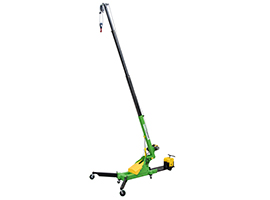
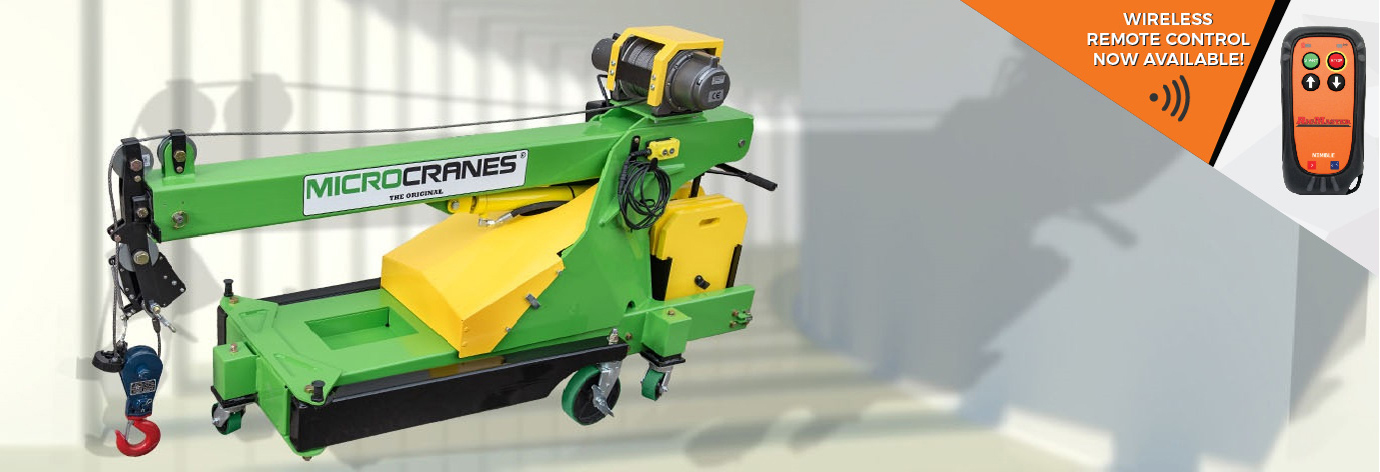
Microcranes® are engineered specifically for restricted-access environments. Their compact footprint allows operators to navigate through many standard doorways, elevators, corridors, rooftops, and tight work zones where conventional lifting equipment often struggles.
For many organizations, solving access challenges creates more value than simply increasing lifting capacity.
Why 2,000 Pounds Is Often the Perfect Capacity
Many lifting applications involve loads between 100 and 2,000 pounds.
Examples include HVAC units, pumps, motors, compressors, generators, valves, electrical equipment, machine components, and industrial process equipment.
Yet many organizations continue using oversized lifting equipment for relatively small loads.
Larger cranes often increase transportation expenses, mobilization costs, labor requirements, scheduling delays, and setup time.
With lifting capacities up to 2,000 pounds (1 ton), Microcranes® provide lifting capability that aligns closely with many common maintenance, installation, and material handling tasks.
Choosing equipment that is properly sized for the application often improves efficiency while reducing operating costs.
The Importance of Lightweight Design
One of the most overlooked buying considerations is machine weight.
Modern buildings frequently contain structural limitations that impact equipment selection.
Commercial rooftops, elevated floors, parking structures, mechanical penthouses, hospitals, schools, data centers, and historic buildings often have strict load-bearing requirements.
Many compact cranes and crawler-type lifting systems weigh several thousand pounds before lifting a load.
Microcranes® are designed with a lightweight philosophy that helps reduce floor loading concerns while expanding the number of locations where lifting operations may be possible.
For rooftop applications, lightweight operation can become a major competitive advantage.
Rooftop Lifting and Load-Bearing Advantages
Modern buildings frequently place HVAC systems, ventilation equipment, pumps, cooling towers, and other critical infrastructure on rooftops.
This creates a unique challenge for contractors and facility managers who must safely install, remove, repair, or replace equipment while working within structural limitations.
Heavy lifting equipment may be difficult to transport to a roof or may create concerns regarding floor loading and roof loading.
Microcranes® offer a practical alternative by combining useful lifting capability with a compact, lightweight design.
For HVAC contractors, facility managers, building owners, and mechanical service providers, this can simplify rooftop operations while reducing logistical challenges.
In many rooftop applications, floor loading matters just as much as lifting capacity.
Height Matters: Reach Up to 27 Feet
A mini crane's usefulness is determined not only by how much weight it can lift but also by where it can move that weight.
Microcranes® provide lift heights approaching 27 feet, making them valuable for rooftop projects, mechanical installations, facility maintenance, elevated equipment servicing, construction applications, signage work, and industrial maintenance.
Many floor cranes and engine hoists simply cannot provide this level of vertical reach.
The best lifting equipment is not simply capable of lifting a load—it must be capable of lifting that load where it needs to go.
Depth Matters: Lowering Loads Below Grade
Not every lifting application involves lifting upward.
Many maintenance projects require lowering equipment deep below grade. This is especially common in water treatment plants, wastewater facilities, pump stations, utility vaults, basements, equipment pits, municipal infrastructure, and industrial facilities.
Microcranes® can be configured for deep lowering applications, with certain configurations capable of lowering loads approaching 135 feet.
This capability creates significant advantages for maintenance personnel who need to remove pumps, motors, valves, blowers, and other equipment from deep service locations.
Many floor cranes, engine hoists, and stationary lifting systems simply cannot provide this type of below-grade access.
Attachments, Winches, Hooks, and Below-the-Hook Options
Many buyers focus on lifting capacity while overlooking adaptability.
A lifting system should be able to evolve with changing job requirements.
Microcranes® can support a variety of winches, lifting hooks, rigging systems, below-the-hook devices, specialty lifting attachments, and application-specific tooling.
This flexibility allows a single crane platform to support machinery moving, pump installation, motor replacement, HVAC handling, generator placement, utility maintenance, glass support, confined-space lifting, and industrial material handling.
Buyers should invest in a lifting system—not just a hook.
Portable Cranes Versus Stationary Davit Cranes
Davit cranes can be valuable tools for specific applications. However, they are typically limited to one location.
Once installed, a stationary crane remains fixed to a rooftop, vault, dock, platform, or maintenance area.
Microcranes® offer a fundamentally different approach.
Instead of bringing the load to the crane, operators can bring the crane to the load.
This mobility allows one portable crane to support multiple departments, facilities, buildings, rooftops, maintenance areas, and job sites.
For many organizations, one portable crane can replace the need for multiple stationary lifting systems.
Faster Deployment Means Lower Costs
The true cost of lifting equipment extends beyond the purchase price or rental rate.
Labor, setup time, transportation, downtime, and scheduling delays often represent the largest project expenses.
Many traditional crane solutions require delivery scheduling, transportation coordination, additional personnel, rigging crews, site preparation, and extended setup procedures.
Microcranes® are designed for rapid deployment.
Operators can quickly position the crane and begin lifting operations without the lengthy mobilization process often associated with larger equipment.
When minutes matter, rapid deployment becomes a major competitive advantage.
One-Person Operation and Labor Savings
Labor costs continue to rise throughout North America.
Organizations increasingly seek equipment that allows fewer workers to accomplish more work safely and efficiently.
Microcranes® support efficient lifting operations without requiring large crews for many common applications.
Many projects that historically required multiple workers manually maneuvering equipment can often be completed more efficiently using a dedicated lifting solution.
For contractors, that can mean more projects completed. For facility managers, it can mean less downtime. For maintenance departments, it can mean faster response times.
Versatility Across Multiple Industries
The best lifting equipment solves more than one problem.
Microcranes® are used across a wide range of industries because they combine the capabilities of a portable crane, mobile hoist, floor crane alternative, material handling system, and restricted-access lifting device into a single platform.
Common applications include HVAC installation, pump removal, generator placement, machinery moving, facility maintenance, roof access lifting, electrical equipment installation, property management, apartment maintenance, hotel maintenance, manufacturing facilities, water treatment plants, wastewater facilities, municipal operations, and industrial maintenance.
One compact crane can often support dozens of different lifting tasks throughout the year.
Battery and Electric Power Advantages
Indoor lifting projects often present unique challenges.
Hospitals, data centers, food processing facilities, laboratories, schools, and occupied commercial buildings frequently require low-noise and low-emission solutions.
Microcranes® are available with battery-powered and electric-powered operating systems that can be well suited for these environments.
Benefits include quiet operation, zero on-site emissions, indoor-friendly performance, reduced environmental impact, and improved operator comfort.
These capabilities help expand the number of locations where lifting operations can be performed efficiently.
Safety and Compliance Should Be a Priority
Safety should never be an afterthought.
Microcranes® are purpose-built lifting systems designed for professional material handling applications.
Manufactured under ISO 9001 quality standards and designed to meet recognized industry requirements including ASME, OSHA, CE, PALD, PASE, and CAN/CSA guidelines, Microcranes® provide a professional-grade lifting solution for demanding applications.
Important safety features include anti-two-block protection, automatic winch braking, safety valves, boom stop systems, safety latches, braking systems, stable counterweight systems, and structural safety factors.
Purpose-built lifting equipment helps create safer working environments while improving precision and control.
No Operator License Required for Many Applications
Many people assume every crane requires a licensed crane operator.
Many lifting applications involving cranes rated at 2,000 pounds and below may not require the same operator licensing requirements associated with larger crane categories.
Employers remain responsible for proper training, safe operation, equipment inspections, jobsite planning, and regulatory compliance.
For maintenance departments, facilities teams, municipalities, and industrial operators, this can improve operational flexibility.
A Better Alternative to Basic Floor Cranes and Engine Hoists
Engine hoists and floor cranes are common because they are affordable and simple.
However, they often suffer from limitations involving reach, height, mobility, positioning control, flexibility, and adaptability.
They may work well in an open shop environment but often become less effective in real-world maintenance environments involving rooftops, confined spaces, elevated work, below-grade lifting, and restricted access.
Microcranes® provide a more capable lifting platform for organizations seeking professional performance.
Return on Investment and Total Cost of Ownership
The right lifting equipment can pay for itself.
Organizations that regularly perform maintenance, repairs, equipment replacement, facility upgrades, or material handling often discover significant long-term savings through crane ownership.
Potential benefits include reduced rental costs, reduced subcontractor expenses, faster project completion, lower labor requirements, improved scheduling flexibility, increased equipment availability, and reduced downtime.
The ability to deploy a lifting solution immediately often creates measurable productivity gains throughout the life of the equipment.
Why Microcranes® Are the Hidden Gem of the Mini Crane Industry
Some equipment attracts attention because it is large. Other equipment earns respect because it consistently solves problems.
Microcranes® have quietly built a reputation as one of the hidden gems of the lifting industry because they address challenges that larger cranes, forklifts, telehandlers, crawler-type compact cranes, floor cranes, engine hoists, and stationary lifting systems often struggle to solve.
Their lightweight design, rooftop-friendly operation, low floor loading characteristics, rapid deployment, battery and electric operating options, compact footprint, lifting height, lowering depth, and broad application range make them uniquely suited for modern maintenance and construction environments.
Final Thoughts: Choose the Crane That Solves the Most Problems
When choosing a mini crane, do not focus solely on maximum lifting capacity.
Consider access, floor loading, rooftop suitability, lift height, lowering depth, safety, attachments, deployment speed, versatility, and return on investment.
For many organizations, the best mini crane is not the largest machine on the market.
It is the machine that consistently completes lifts safely, efficiently, and profitably.
That is where Microcranes® continue to stand apart as one of the most practical and valuable lifting solutions available today.
One Mini Crane. Hundreds of Applications. Thousands of Opportunities to Save Time and Money.
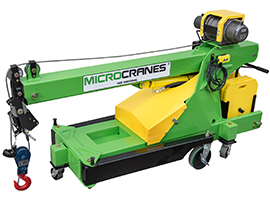
Compact Crane
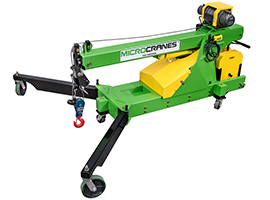
Outrigger Legs
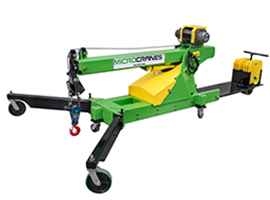
Counterweight Extended